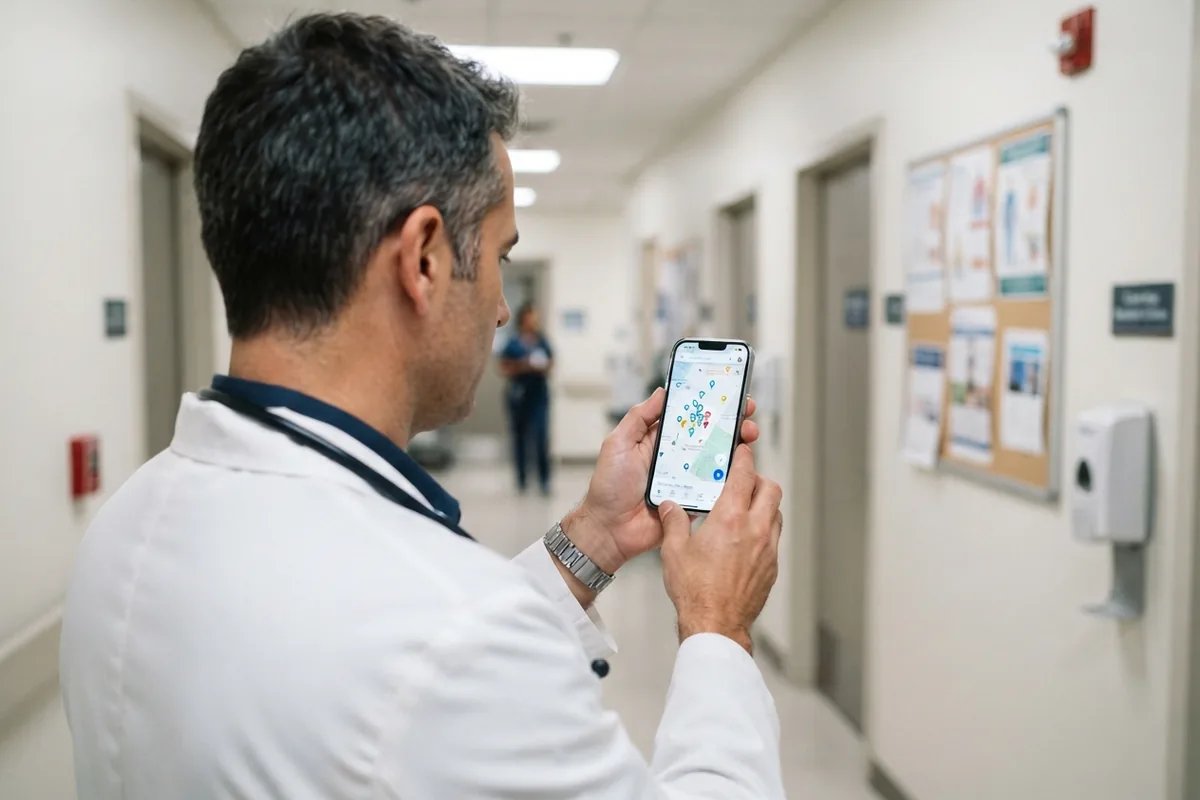
- Your ranking is different on every street. Measure it on a grid around the clinic, not by searching from your own chair.
- In the 2026 survey of local SEO specialists, primary category, distance and keywords in the business name are the top three factors. "Open at the time of search" came in at number five.
- Predefined services on the profile jumped from 81st to 22nd place since 2023. Most clinics still leave them empty.
- Competitors with "best dentist" in their name rank because of the name. Report them; don't copy them.
- AI-written profile text and AI-generated photos are now listed as negative factors.
First, check where you actually rank
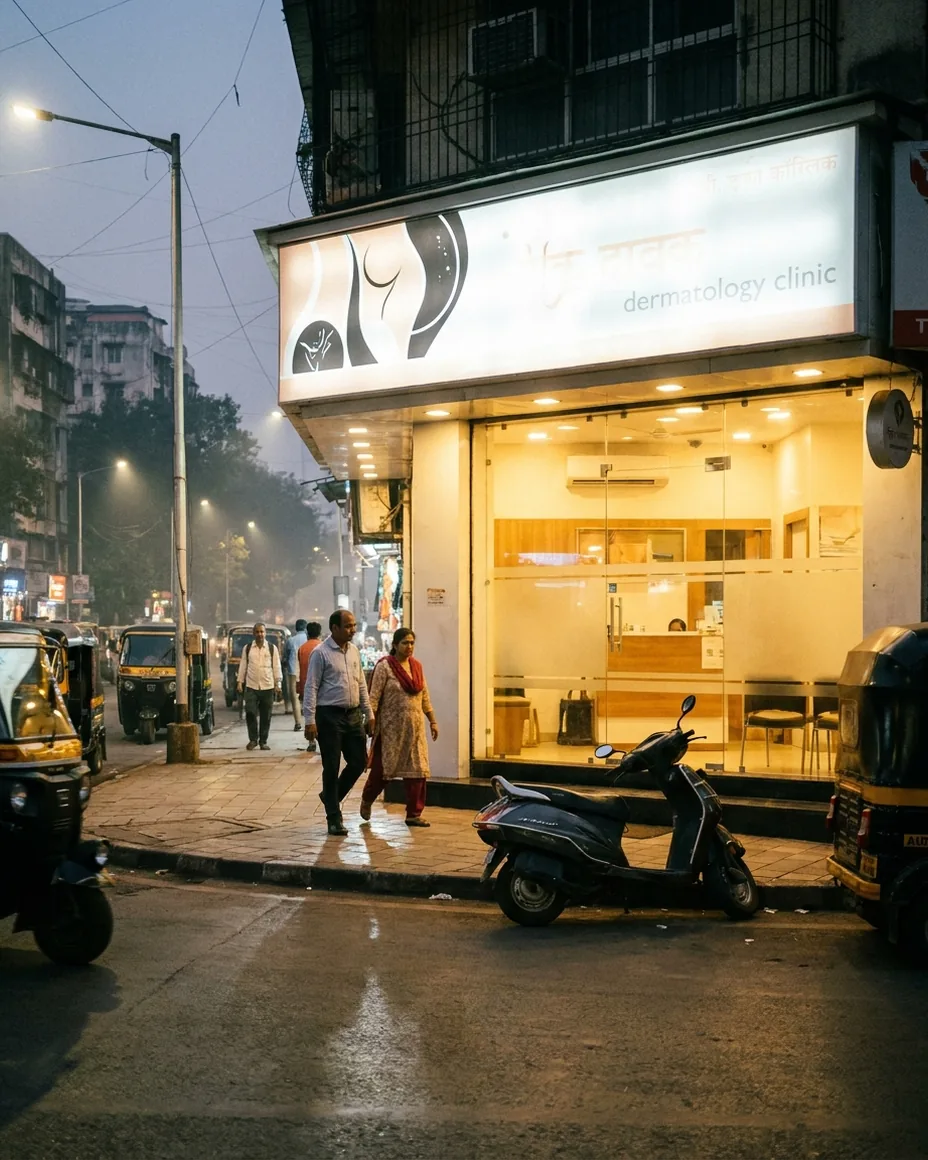
Most doctors check their ranking by typing "dentist near me" on their own phone, sitting inside the clinic. Of course the clinic comes first. Google is showing the closest dentist to the person searching, and that person is sitting in the clinic.
Patients search from their homes, their offices and the market, not from your chair. So the honest way to check is a ranking grid: the same search checked from many points around the clinic, for example a 7 by 7 grid spread over three kilometres. Tools like Local Falcon, BrightLocal or Whitespark do this. The result usually looks like this:
- Rank 1 to 3 in the few blocks around the clinic.
- Rank 4 to 10 a little further away.
- Not in the top 20 beyond one or two kilometres, especially in the direction of a competitor.
Your goal is not "rank 1". Your goal is to make the green area on that grid bigger, especially towards the localities where your patients actually come from.
Check three kinds of searches, because they behave differently:
| Search type | Example | What decides it most |
|---|---|---|
| "Near me" | dentist near me | Distance from the patient, then category and reviews |
| Locality or city | skin specialist in Civil Lines | Being in that area, plus how well your profile and website match it |
| Treatment | root canal treatment in Bareilly | Services on your profile, and a matching page on your website |
Write down where you are today for 8 to 10 of these searches. Without this starting point, you won't know later whether anything you changed actually helped.
How Google ranks clinics on Maps
Google's own help page says local results are based mainly on relevance, distance and prominence, and that "there's no way to request or pay for a better local ranking". It doesn't say how much each signal weighs. The closest thing we have is Whitespark's 2026 Local Search Ranking Factors survey, where local SEO specialists score what they see working. These are its top 20 factors for the map results, and what each one means for a clinic:
| Rank | Factor | For a clinic, this means |
|---|---|---|
| 1 | Primary category | "Dentist", "Dermatologist", "Homeopath": the single most important choice |
| 2 | Distance to the person searching | Fixed. You can only win more of the area around you |
| 3 | Keywords in the business name | Only if they're genuinely in your registered name. Adding them gets profiles suspended |
| 4 | Address in the city being searched | A clinic just outside city limits struggles for searches like "dentist in Bareilly" |
| 5 | Open at the time of search | Evening hours matter, because many patients search after work |
| 6 | High rating | 4 to 5 stars |
| 7 | Address shown on the profile | Clinics should show their address; home-visit services are different |
| 8 | Additional categories | Only ones that describe what you are |
| 9 | Number of Google reviews with text | A few lines from patients beat bare stars |
| 10 | Correct map pin | The pin on your building, not the road or the complex gate |
| 11 | Recent reviews | A newest review from last week, not last year |
| 12 | Distance to the centre of the city | Fixed. Clinics near the city centre have an edge for city searches |
| 13 | Click-through rate from Maps | Patients choosing you when they see you |
| 14 | Steady flow of reviews | Ten a month beats forty in one weekend |
| 15 | Website name, address and phone match the profile | Same details, written the same way |
| 16 | Complete profile | Every field filled in |
| 17 | Keywords in the linked page's title tag | The page your profile links to should name your specialty and locality |
| 18 | Locality relevance of website content | Your website should talk about your area, naturally |
| 19 | Removing spam listings | Reporting fake or keyword-stuffed competitors |
| 20 | Keywords in the linked page's headings | Same as the title tag, on the page itself |
This is a survey of expert opinion, not data from Google. It is still the best guide available.
Two changes from the 2023 edition are worth knowing. "Open at the time of search" is new and went straight to fifth place. And predefined services on the profile rose from 81st to 22nd, with keywords in services rising from 110th to 35th. Both are things a clinic can fix in an afternoon.
The things you can't change, and what to do about them
Three of the top 12 factors are about where your clinic physically is: distance to the patient, an address in the city being searched, and distance to the city centre. No agency can change these, and anyone who says otherwise is planning something risky, like a fake address.
What you can do:
- Accept the radius and win it fully. For most single clinics, the realistic goal is the top three in your own locality and the next two or three around it. That's where most of your patients come from anyway.
- Use your website for wider searches. A patient travelling across the city for an implant or an IVF consultation searches differently and reads more. Treatment pages on your website can reach them where Maps can't.
- Never use a virtual office or a friend's address to appear in a better area. Google requires an address where patients are actually seen during the listed hours, and this is one of the most common reasons for suspension.
- If you're opening a new clinic, think about this before you sign the lease. A clinic on a main road inside the locality patients search for will always have an easier time than one just outside it.
Profile fixes, in order of impact
Our Google Business Profile setup guide for doctors covers every field in detail. For ranking, these are the fixes we do first, in this order:
- Primary category. Choose the most specific one that describes what you are. A skin clinic listed as "Medical clinic" competes with every general practice and rarely wins "dermatologist" searches.
- Hours, including evenings and holidays. Show split hours if the doctor sits morning and evening. If you are closed at 8 pm, you drop out of 8 pm searches. Set special hours before every festival.
- Services. Add Google's predefined services for your category first, then custom services for every treatment you offer, in plain words patients use: "Root canal treatment", not "Endodontic therapy".
- Additional categories. Only those that complete "this clinic is a…". Two or three accurate ones are better than nine loose ones.
- Map pin. See the next section. It is more often wrong than you would think.
- Everything else filled in: description, attributes like wheelchair access and parking, appointment link, opening date, and real photos.
Make these changes over a week or two, not in one sitting. Several big edits at once, especially to name, category and address, can trigger a new verification or a review of the profile.
The map pin problem
Correct pin placement is the tenth most important factor, and in Indian cities it is wrong surprisingly often. Common cases we see:
- A clinic on the second floor of a market complex, with the pin on the complex gate or in the middle of the parking.
- A pin on the main road because the address was typed as "near" a landmark, while the clinic is in the lane behind it.
- A clinic inside a hospital building where the pin sits on the hospital, so Google treats the two as competing for the same spot.
- A pin placed years ago at an old address after the clinic moved.
Open your profile on Google Maps in satellite view, zoom in fully, and check that the pin is on your building, as close to the entrance patients use as possible. If it isn't, edit the address and drag the pin. Also tap "Directions" from a nearby road and see where Google actually sends people. A wrong pin costs you rankings and, worse, patients who give up looking for the entrance.
Why spammy competitors rank above you, and what to do
Look at the Maps results for your specialty and you will probably see names like "Dr Sharma Best Skin Clinic Hair Fall Treatment Bareilly". They often rank well, because keywords in the business name are the third strongest factor. That's exactly why Google's guidelines don't allow it: the name must be the real-world name, the one on the signboard and letterhead.
Don't copy it. It works only until a competitor reports you, and then the profile can be suspended, and getting it back takes weeks. Instead, report the competitor. "Removal of spam listings" is the 19th factor on the list: every spam profile that disappears moves you one place up, without touching your own profile.
- Check their real name on the signboard (visit or check Street View), their website and their letterhead. Take screenshots.
- Suggest an edit on their Maps listing, correcting the name to the real one. Sometimes this alone works.
- If it doesn't, use Google's Business Redressal Complaint Form, quote Google's rule that the name must reflect the real-world name, and attach your evidence. These go to a person on Google's spam team.
- Do the same for fake listings: a "clinic" at an address with no clinic, or one doctor with five profiles across the city.
Be fair about it. Report only clear violations, with evidence. A competitor whose registered clinic name really is "City Skin and Hair Clinic" is not breaking any rule.
Reviews and ranking
Four of the top 14 factors are about reviews: a high rating, the number of reviews with text, how recent they are, and a steady flow over time. What this means in practice:
- A clinic with 40 genuine reviews and a new one every few days usually does better than a clinic with 150 reviews where the newest is eight months old.
- Bursts look suspicious. Fifty reviews after one health camp, and then nothing, is the pattern Google's filters look for.
- Reviews with a few lines of text count more than bare star ratings. You can tell patients that a few lines help others decide. You can't tell them what to write.
The only reliable way to get this is a routine at the clinic that asks every patient the same way. Our guide on getting more patient reviews without breaking the rules explains the full routine, including the April 2026 rules against staff targets. If a bad review is already hurting you, read how to remove bad reviews from Google. Replying to reviews barely moves rankings, but patients read the replies, so keep doing it.
Your website's role in Maps ranking
Many doctors think the Google profile and the website are separate. They are not. Five of the top 20 factors are about the website your profile links to:
- Same name, address and phone on the website as on the profile, written the same way. "Shop 4, 2nd floor" on one and "S-4, Second Floor" on the other is not a disaster, but the closer they match, the better.
- A title tag with your specialty and locality. For example: "Dental clinic in Civil Lines, Bareilly | Smile Dental". Not "Home".
- Headings that say the same thing, naturally, on the page itself.
- Content about your area: how to reach you, the landmark, parking, which localities patients come from. Written for patients, not stuffed with area names.
- A page for each main treatment, so treatment searches have something to match.
If your profile currently links to a Facebook page, a Practo profile or no website at all, you are missing these signals completely. This is one of the main reasons we build a clinic website alongside the profile, and why website SEO and Maps ranking work best together.
Getting patients to click on you
Click-through rate from Maps is the 13th factor. When patients see three clinics and keep choosing yours, it seems to help you rank. You can't fake this, and you shouldn't try: paying people to search and click is manipulation, and tools that promise it are a fast way into trouble. But you can make your listing the one patients want to tap:
- A clear, real cover photo of the clinic front or reception, not a logo or a stock image.
- Correct hours, so you show "Open" when the patient is looking.
- A rating and recent reviews that make the choice easy.
- An appointment link and a phone number that is actually answered. A call that rings out sends the patient back to the list.
Directories, mentions and AI search
Citations, meaning listings of your clinic on other websites, have been losing weight in Maps rankings for several years. But the same survey found something new for 2026: in AI search, mentions matter a lot. Three of the top five factors for appearing in AI answers were about citations. As the report puts it, "mentions are the new link".
For Indian clinics, the listings worth getting right are:
- Practo, Justdial, Sulekha and Lybrate, with the same name, address, phone, timings and qualifications as your Google profile.
- The doctor's page on every hospital or clinic website where they consult.
- Your IMA, IDA or specialty association chapter listing, if there is one.
- Local news or community sites, if you have done a health talk or a camp.
- LinkedIn for the doctor, matching the website's About page.
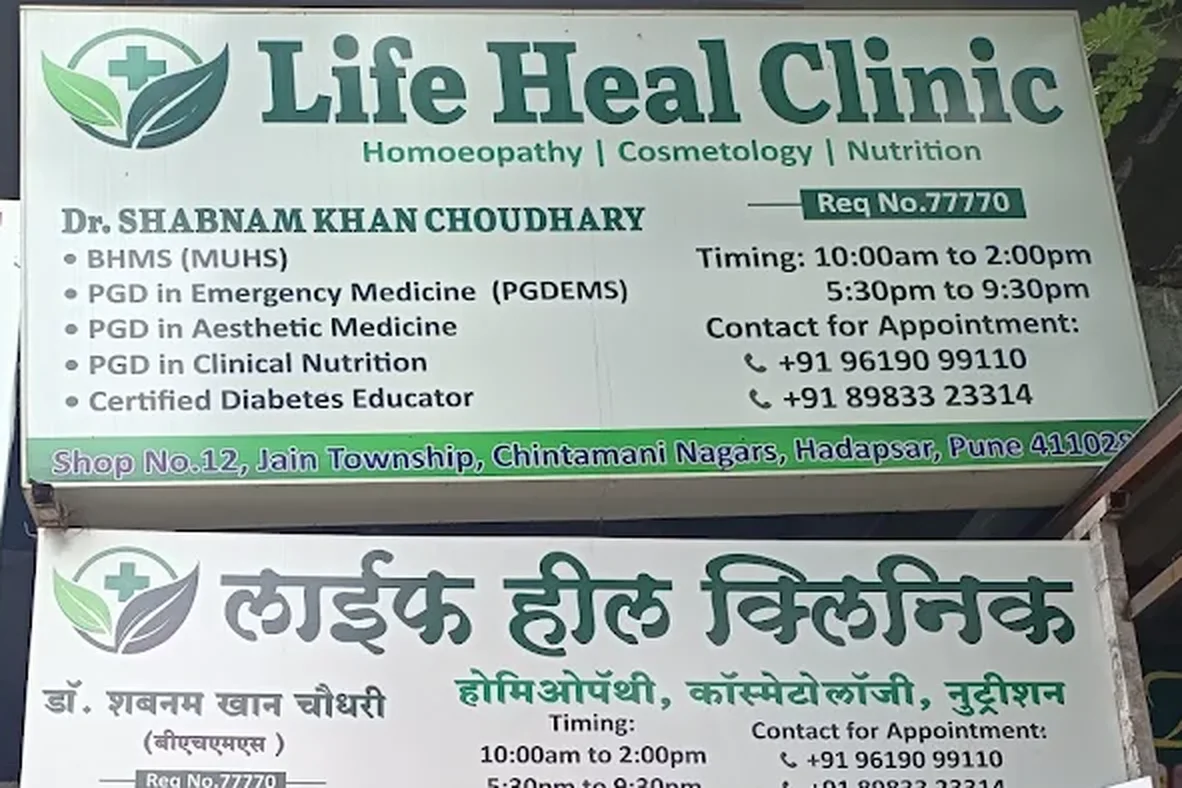
Here's a real example of why this matters. For Life Heal Clinic in Pune, a new homeopathy clinic, we made the doctor's details match on the Google profile, website, Practo, Justdial and LinkedIn. By August 2026, Google's AI Overview described the clinic correctly, with address, doctor and timings, even for someone searching from Meerut, more than 1,000 km away. Profile views rose from 649 in July 2026 to 1,178 in August, and five of the eight locality searches we track for the website were in Google's top 10.
What doesn't work, or gets you in trouble
For the first time, the 2026 survey also lists factors that hurt rankings or risk suspension. Several are things clinics do every day:
| Write this | Not this |
|---|---|
| Allowed A description written in your own words about what you treat | Not allowed A description stuffed with "best dentist Bareilly dental clinic near me" |
| Allowed Real photos of your clinic and team | Not allowed AI-generated photos or videos of a clinic that doesn't look like yours |
| Allowed Posts written for patients, once a week | Not allowed AI-written posts packed with keywords every day |
| Allowed One profile per real location | Not allowed Extra profiles at other addresses to cover more areas |
| Allowed Your website domain linked directly | Not allowed A link that redirects to a different domain |
Some popular tips simply don't do much. In our experience, adding location data to photos, renaming photo files with keywords, and posting every day don't move rankings in any way we can measure. The time is better spent on the fixes above.
Doctors have one more limit. Under the NMC's October 2026 advertising guidelines, profile posts and descriptions can't include discount offers, "best" or "No. 1" claims, or patient testimonials. A plain, factual profile ranks just as well, and keeps you out of trouble with your council.
How long it takes
Honest timelines, from what we see across clinics:
| Change | When you usually see an effect |
|---|---|
| Category, hours, services, pin | A few days to a few weeks after the edit goes live |
| Reporting spam competitors | Days to weeks, depending on Google's review |
| Steady new reviews | Builds over two to three months |
| Website matching the profile | One to three months |
| Wider area and competitive cities | Six months or more, and some areas a single clinic won't win |
A new clinic with an empty profile usually sees the biggest jump in the first month, because it starts from nothing. An established clinic that is already visible will move more slowly. And nobody can promise a top-three position on Maps, because Google decides it, and the patient's location changes it every time.
A 30-day plan
Week 1: measure and fix the basics
- Run a ranking grid for 8 to 10 searches and save the results.
- Check the primary category, hours (including evenings) and holiday hours.
- Check the map pin in satellite view, and fix it.
Week 2: services and the website
- Add all predefined services, then every treatment as a custom service.
- Make the website's name, address and phone match the profile exactly.
- Fix the title tag and main heading of the page your profile links to.
Week 3: reviews and directories
- Start a review routine at reception that asks every patient, the same way.
- Correct Practo, Justdial, Sulekha and Lybrate so they match the Google profile.
- Add 10 to 15 real photos.
Week 4: competitors and the next round
- Check the top results for spam names or fake listings, and report clear violations with evidence.
- Schedule a month of weekly posts.
- Run the ranking grid again and compare with week 1.
This is exactly what our Google Business Profile management covers, from ₹6,999 a month, with a ranking grid report every month. If you want to see your own grid first, ask for a free audit.
- Google Business Profile Help: tips to improve your local ranking
- Whitespark: Local Search Ranking Factors 2026
- SEO Madman: what moved in Whitespark's 2026 report
- Google: guidelines for representing your business on Google
- BrightLocal: how to deal with Google Business Profile name spam
- Google: Business Redressal Complaint Form
- MapMyClinic: Life Heal Clinic case study (Google Business Profile Performance report, July and August 2026)
- MapMyClinic: NMC advertising rules, including the October 2026 guidelines

Faiz, Head of SEO
Faiz has worked in SEO since 2014 and leads Google Business Profile and local SEO work at MapMyClinic.
More from Faiz