- Ask every patient, not only the happy ones. Selective asking is banned.
- Timing matters: pick a fixed point in care for each service, such as the last sitting or the first follow-up, and ask everyone who reaches it.
- Since April 2026, Google bans review targets for staff and requests to mention a staff member.
- Google now removes suspicious reviews, can block new ones for a while, and shows warnings on profiles, including in India.
- Doctors have extra limits: medical ethics rules on self-promotion, consumer rules on endorsements and, from May 2027, consent rules for messaging patients.
Why reviews matter more now
Patients have always asked friends before choosing a doctor. Now they read strangers' reviews too, and they're getting stricter about what they'll accept. BrightLocal's 2026 consumer survey (of adults in the US; in our experience the pattern is similar in Indian cities) found:
- 97% read reviews before choosing a local business.
- 74% look for reviews from the last three months, and a third want reviews from the last two weeks.
- 68% won't consider a business below four stars, and 31% want 4.5 or higher, up from 17% a year earlier.
- 89% expect the owner to reply to reviews.
- 82% read the AI-written review summaries that Google and other apps now show.
That last point is new. Google summarises your reviews with AI, and its AI features, including Ask Maps, answer questions using what patients have written. What patients say about waiting times, staff and explanations now reaches people who never scroll down to read a single review.
Reviews also affect where you rank on Google Maps. Whitespark's 2026 survey of local search specialists ranks review signals among the most important groups for Maps rankings, second only to your Business Profile itself, and says their weight grew more than any other group this year. Here's how the individual signals ranked:
| Review signal | Rank among Maps factors | What it means for a clinic |
|---|---|---|
| High Google rating | 6th | Patients and Google both favour higher averages |
| Number of reviews with text | 9th | A few lines beat a bare star rating |
| Recency of reviews | 11th | A profile whose newest review is months old looks inactive |
| Steady flow over time | 14th | Ten a month beats forty in one weekend |
| Keywords in reviews | 36th | Minor, and you're not allowed to ask for them |
| Owner replies to most reviews | 122nd | Little ranking effect, but patients expect them |
Sterling Sky's small tests add two useful details. Businesses saw a small ranking lift on reaching ten reviews, with no further jump at eleven. And adding keywords to reviews didn't improve rankings in their test, which is one more reason not to ask for them.
What Google allows and bans
Google's policy allows businesses to ask for reviews that reflect a genuine experience, without offering anything in return. Everything else follows from that.
| Write this | Not this |
|---|---|
| Allowed Asking every patient for an honest review | Not allowed Asking only the patients you think are happy |
| Allowed Giving a link or QR code they can use later | Not allowed Pressuring or requiring patients to review while at the clinic |
| Allowed Saying a few lines help other patients decide | Not allowed Asking them to mention a doctor, a treatment or keywords |
| Allowed Asking staff to hand the card to every patient | Not allowed Giving staff a target number of reviews |
| Allowed Thanking patients for any review, good or bad | Not allowed Offering a discount, free follow-up or gift for a review |
| Allowed Letting patients review in their own words | Not allowed Reviews from staff, family, friends or other doctors you know |
The two newest rules, added on 17 April 2026, ban review targets for staff and requests for reviews that name a staff member. Both were common in clinics: reception contests, and “please mention Dr Rao” requests. Google's policy also says businesses shouldn't require or pressure patients to leave reviews while on the premises.
Enforcement has become much tougher. Google blocked or removed more than 292 million policy-breaking reviews in 2025, most before anyone saw them. Since 2025, profiles caught with fake reviews can be restricted: no new reviews for a period, existing reviews hidden, and a warning to patients that fake reviews were removed. The warnings started in India, the US and the UK and have since expanded. Google Maps has also been seen asking users, “Does this business offer rewards in exchange for reviews?”
Indian rules to know
Google's rules are only half of it. Doctors in India work under several other sets of rules that affect how reviews are collected and used.
Medical ethics
The Medical Council's 2002 code of ethics is the one in force; the NMC's 2023 regulations were put on hold in August 2023. The 2002 code bars doctors from soliciting patients directly or indirectly and from boasting of cases, cures or remedies. The on-hold 2023 regulations went further and told doctors not to request or share patient testimonials, recommendations or reviews on social media. They're not in force, but they show where the regulator's thinking is. Our practical reading: a neutral request for honest feedback is widely accepted; pushing for five-star reviews and reposting them as promotion is where risk begins.
Consumer protection
Under the Consumer Protection Act, fake reviews can be treated as an unfair trade practice. If you use a patient's review in an ad, the CCPA's 2022 endorsement guidelines apply: it must reflect the patient's genuine, current opinion, based on real experience. Penalties can reach ₹10 lakh, and ₹50 lakh for repeat offences. The BIS standard on online reviews (IS 19000:2022), which bars suppressing negative reviews and publishing biased ones, is voluntary so far; in 2024 the government proposed making it mandatory, but hasn't done so yet.
Cure claims
A review saying “the doctor cured my diabetes” is the patient's opinion on Google. Reposted by the clinic in an ad, it becomes your claim, and ads linking a medicine or remedy to conditions listed in the Drugs and Magic Remedies Act, such as diabetes, obesity or sterility in women, carry legal risk. This matters especially for homeopathy and Ayurveda clinics.
Data protection
WhatsApp's own business policy already requires a person's opt-in before a business messages them. On top of that, under the Digital Personal Data Protection Act and its 2025 Rules, formal consent and notice duties apply from May 2027; after that, a review request or promotional message needs consent for that purpose, with a way to withdraw it. Start now: add a line to your registration form asking whether patients agree to receive visit follow-ups and feedback requests on WhatsApp, and keep a record.
General guidance, not legal advice.
A review routine that works
Clinics with many reviews rarely have a secret. They have a routine that runs every day without the doctor thinking about it. Here's the one we set up:
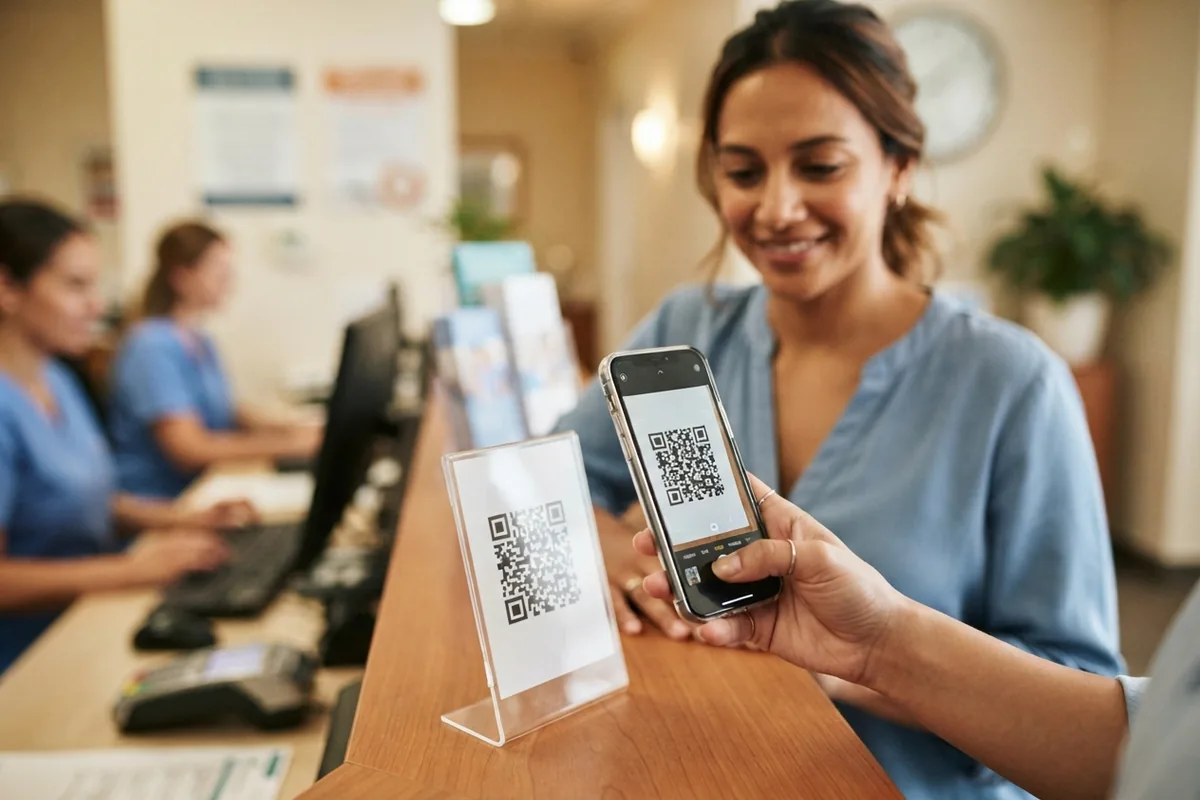
- Create your review link and QR code. In your Business Profile, open Reviews and select “Get more reviews”. Copy the link, and download the QR code (currently only possible from a computer browser, not the phone app).
- Put the QR code where patients wait, not where they pay. A small stand in the waiting area or a card handed with the prescription lets patients scan it and review later, at home.
- The doctor mentions it once. At the end of every consultation at that point in care, a short, neutral line from the doctor carries more weight than any card.
- Reception sends the link on WhatsApp the same evening to every patient who reached that point in care that day and has agreed to messages. Not just the ones who seemed happy.
- One reminder at most. If the patient hasn't reviewed after a few days, one gentle reminder is fine. After that, leave it.
- Reply to every review within a week, ideally within 48 hours.
A WhatsApp message that works, tied to the specific visit and free of anything promotional:
“Hello Mr Sharma, thank you for visiting Smile Dental Clinic today. If you have a minute, we'd value an honest review of your visit on Google: [review link]. You don't need to mention any health details. Thank you, Team Smile Dental”
If you send messages through the WhatsApp Business API, a request tied to a specific visit like this can qualify as a utility message. A generic “please review us”, or one mixed with an offer, is treated as marketing, which costs more. Either way, the patient must have opted in.
When to ask, by specialty
The biggest difference between clinics that get reviews and clinics that don't is timing. Ask too early and there's nothing to say; ask too late and the visit has faded. The rule that keeps you within Google's policy is simple: pick a fixed point in care for each service, and ask every patient who reaches it, whether or not they've improved. Choosing the moment based on how happy a patient seems is selective asking, which Google bans. In our experience, these points work well:
| Specialty | Fixed point to ask every patient | Why this point |
|---|---|---|
| Dentistry | At the final sitting of the treatment plan (for a one-visit treatment, the same evening) | Mid-treatment, there's nothing complete to review yet |
| Dermatology | At the first scheduled follow-up | The first visit only has a prescription to show for it |
| Physiotherapy | At a set session, such as the fourth, or at discharge | Patients have enough experience of the clinic to describe it |
| Homeopathy and Ayurveda | At the first scheduled follow-up | Treatment runs over weeks, so the first visit is too early |
| General OPD | The same evening, by WhatsApp | The visit is fresh and usually complete |
| Hospitals | After OPD billing, and a few days after discharge | Asking at discharge, while a family is tired and settling a bill, rarely goes well |
Write the point down for each service, so reception follows the rule rather than their impression of the patient.
What to say
Most review requests go wrong in the wording. The same request can be perfectly fine or a policy breach depending on a few words:
| Write this | Not this |
|---|---|
| Allowed “If you have a minute later, we'd value an honest review on Google.” | Not allowed “Please give us five stars.” |
| Allowed “Here's the link. It takes about a minute.” | Not allowed “Can you do it now, before you leave?” (pressure on the premises) |
| Allowed “You don't need to mention your health problem.” | Not allowed “Please mention Dr Rao and the root canal.” |
| Allowed “A few lines about your visit help other patients decide.” | Not allowed “We'll give you 10% off your next visit.” |
Train reception with these exact lines, and put them on a card at the desk. New staff pick up whatever the last receptionist said, including the bad habits.
Why patients don't write reviews
Most patients who liked their visit still don't review. The reasons we hear most:
- Privacy. Reviews appear under their Google name, and they don't want a health problem linked to it. Tell them plainly they can write about the clinic, the staff and the wait without mentioning their condition.
- They don't know how. Older patients especially. A direct link that opens the review box is far easier than “search for us on Google”.
- They forget. A request at the desk is forgotten by the time they reach the car. The WhatsApp message that evening is what gets done.
- They think it doesn't matter. One line explaining that reviews help other patients choose a doctor changes that for many people.
Some specialties will always get fewer reviews. Patients of psychiatrists, fertility clinics, sexual health and some gynaecology practices are understandably reluctant to be visible. Don't push harder; ask the same neutral way and accept a slower pace.
Replying to reviews
Reply to every review, positive and negative, in a line or two of your own words. Google checks replies against its content policy before posting them, and its policy bans sharing medical or personal information about anyone. So never confirm that the reviewer was your patient or mention their treatment, even in a thank-you:
| Write this | Not this |
|---|---|
| Allowed “Thank you for your kind words. We're glad the visit went well.” | Not allowed “Glad your root canal went well, Mr Sharma!” |
| Allowed “Thank you. We'll pass this on to the team.” | Not allowed The same pasted reply under every review |
Patients notice replies copied from an AI tool or pasted under every review. A short, specific reply does more. For negative reviews, the approach is different: wait before replying, never argue, and move the conversation to a phone call. We explain it with examples on our reputation management page.
Fake and unfair reviews
Apart from the reviewer deleting it, only reviews that break Google's policies can be removed: fake reviews, off-topic rants, reviews from competitors or ex-employees (a conflict of interest), abuse, or reviews that reveal someone's personal information. A genuine bad experience stays, however unfair it feels.
- Report it from your profile or through Google's Reviews Management Tool. Evaluation usually takes several days, and the tool shows whether it's pending, rejected or escalated.
- If it's rejected, you can appeal once per review, and include up to ten reviews in one appeal.
- Reply calmly meanwhile, without saying whether the person was a patient, and invite them to call the clinic.
- Never pay anyone to remove reviews. Google's April 2026 report specifically mentions scams that demand payment to remove negative reviews. Only the reviewer or Google can remove a review.
Mistakes that get reviews removed
When doctors tell us their reviews are disappearing, in our experience one of these is almost always behind it:
- Early reviews from family, friends and staff to “get started”. Google treats these as a conflict of interest, and they can bring genuine reviews down with them.
- Doctors' WhatsApp groups where members review each other's clinics.
- A burst of reviews after a health camp or a staff push, then nothing for months.
- “Review packages” bought from agencies or freelancers.
- Free follow-ups, discounts or small gifts offered for a review.
- Reception contests or targets, now explicitly banned.
- Patients asked to review on a clinic phone or tablet before leaving. Many reviews from one device can look suspicious.
If your profile has already been restricted, stop anything on this list at once, wait out the restriction, and appeal if you believe it was a mistake. Then rebuild slowly with a routine like the one above.
What to track
Check these once a month:
- New reviews this month, compared with new patients seen. The ratio tells you if the routine is actually running.
- The date of your newest review. If it's more than a few weeks old, something has stopped.
- Your average rating, compared with the three clinics that outrank you on Maps.
- What patients mention. Repeated complaints about waiting, fees or a staff member are a management problem, not a marketing one.
- Reviews without a reply.
Checklist
- Review link and QR code created from your Business Profile.
- QR stand in the waiting area; cards with prescriptions.
- A neutral script for the doctor and reception, printed at the desk.
- WhatsApp consent line on the registration form.
- Same-evening WhatsApp message to every patient who reaches the fixed point in their care.
- One reminder at most.
- Every review replied to within a week, in your own words.
- No incentives, no targets, no family or staff reviews, and patients review on their own phones.
- A monthly check of count, newest review date, rating and themes.
Setting up and running this routine is part of our Google Business Profile management, from ₹6,999 a month. Start with a free audit to see how your reviews compare with the clinics near you. For the rest of your profile, read our Google Business Profile guide for doctors.
- Google Maps user-generated content policy: fake engagement
- Google: tips to get more reviews and create a review link or QR code
- Google: review restrictions on Business Profiles
- Google: report reviews for removal
- Google blog: protecting businesses on Maps (2025 figures)
- Google blog: fake review warnings in the US, UK and India
- Search Engine Roundtable: April 2026 review policy update
- PPC Land: Google Maps asking users about review rewards
- WhatsApp Business Messaging Policy
- BrightLocal Local Consumer Review Survey 2026
- Whitespark Local Search Ranking Factors 2026
- Sterling Sky: review count and rankings and keywords in reviews
- NMC: 2023 professional conduct regulations (held in abeyance)
- PIB: consultation on fake reviews and IS 19000:2022
- PIB: DPDP Rules 2025 explainer
- Meta: WhatsApp template categories
- LiveLaw: Madras High Court on Google reviews and defamation

Faiz, Head of SEO
Faiz has worked in SEO since 2014 and leads Google Business Profile and local SEO work at MapMyClinic.
More from Faiz